 2024 — now
 2023 — 24
 2022 — 23
 2019 — 22
 Bosch · 2019
 JWT / WPP · 2018


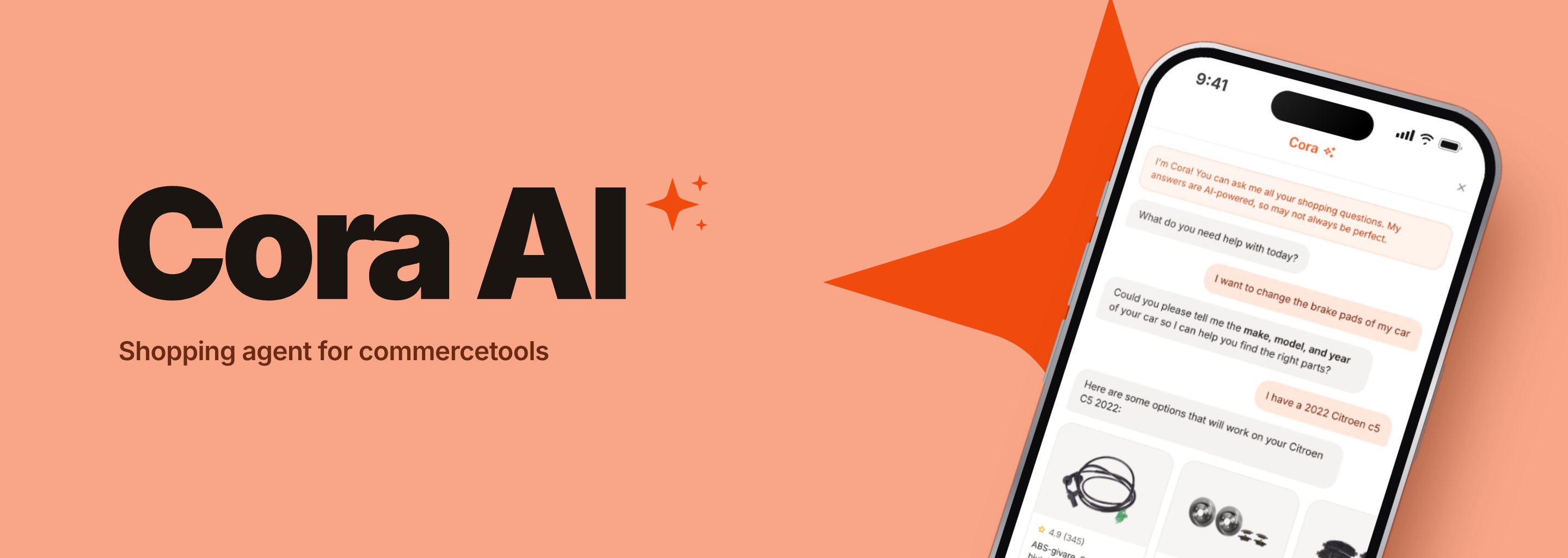
Cora: a shopping assistant that remembers you, wherever you continue.
A persistent, multimodal assistant that keeps a shopper's intent, cart and conversation intact across onsite chat, voice and WhatsApp. Our design partner was a Nordic car spare parts retailer, where shoppers rarely know which part they need.
Cora didn't launch as a standalone product. The work became an integration connecting commercetools to Google's agentic commerce tools.
Brake pads
248 parts that fit your Citroen C5 2022
Desktop · shopping agent
An agent beside the catalogue
Cora lives next to the product list, knows the shopper's car, filters the catalogue to parts that fit, and turns "my brakes squeal" into a complete brake job with one bundle total.
Built-in trust
Fitment checked for every result
"Fits my car" is on by default, and Cora says so. Turn it off and the banner warns that parts may no longer fit.
Explain the bundle
Why these three parts?
One tap on "Why these?" and Cora explains the role of every item, so the shopper buys a repair, not a guess.
Ask Cora to compare, tap "Why these?", add the bundle, toggle "Fits my car"
Mobile · three entry flows
Start from what the shopper needs
Research showed car parts shoppers arrive with one of three needs, so the mobile chat has a flow for each. Every flow identifies the car before suggesting anything, so each card is guaranteed to fit.
- Problem first: "my brakes squeak". Cora narrows down the cause, then suggests compatible parts.
- Task first: "help with a DIY project". Cora narrows the search, then builds an editable project bundle.
- Tool & parts: "I want to change my brake pads". Straight to parts that fit.
Design note
Incite interaction and educate
Shoppers don't always know why a bundle holds each item. "Why do I need this?" makes Cora explain the purpose of every part in the project.
Pick a flow, tap Cora's suggestions, remove an item from the bundle
Research
Interviewed 25+ people about their needs and expectations of chatbots. Built three personas and end-to-end journey maps.
Agree on success
Set six measurable targets with the client before designing anything.
Frame with the partner
Mapped the three ways shoppers arrive: something is wrong, I want to do a job, what do I need for it.
Prototype
Designed the assistant for web, mobile and WhatsApp, plus merchant configuration. WhatsApp Business guidelines shaped the message templates.
Test & QA
20 usability sessions across three scenario tasks, anonymous and returning shoppers. Then QA on conversational edge cases.
With our design partner, a car spare parts retailer, the research grouped shoppers by what they arrive with. Each persona maps to one of Cora's three flows.
The first-time shopper
Arrives with a symptom: My car won't start.
- Core pain
- Doesn't know which part fixes it, or whether the car is still safe to drive.
- Job to be done
- When my car starts acting weird, I want to understand what's wrong and how urgent it is, so I can fix it safely without buying the wrong part.
- So Cora
- Identifies the car, asks diagnostic follow-ups, flags safety and says when to see a mechanic.
The returning DIYer
Arrives with a job: I want to replace my brake pads.
- Core pain
- Has to piece together parts, tools and instructions across many pages.
- Job to be done
- When I take on a repair myself, I want everything for the job in one place, so I can finish it in one go without a second trip.
- So Cora
- Narrows by budget and brand, then bundles the parts with difficulty, steps and common mistakes.
The advanced DIYer
Arrives with a shopping list: What do I need to change spark plugs?
- Core pain
- Filters don't confirm compatibility, so wrong parts slip into the cart.
- Job to be done
- When I know the job, I want to be sure every part fits my car, so I don't lose a weekend to a return.
- So Cora
- Recommends only compatible parts, explains why specs matter and warns against common mistakes.
Before the design partner, 25+ interviews produced three broader e-commerce personas. Their needs carried straight into the car parts flows:
- Maria, 28, the mobile-first discoverer: overwhelmed by endless grids; wants a personal-shopper conversation instead of rigid filters.
- David, 45, the loyal but impatient shopper: expects to be recognised and given plain-language comparisons, not spec tables.
- Lily, 35, the anxious post-purchase problem solver: needs a real answer about a late order, not a chatbot that loops to the FAQ.
| Decision | Why | Trade-off we accepted |
|---|---|---|
| Context over channels: one persistent session across web, voice and WhatsApp | Shoppers shouldn't repeat themselves when they switch device or pause | WhatsApp needs an opt-in and consent step before the handoff |
| Start from what the shopper needs: separate flows for a symptom, a job and a parts list | Car parts shoppers rarely arrive with a part number | Three flows to maintain, and a misread intent needs a clarifying question |
| Identify the vehicle first, by model and year or plate number | Every recommendation has to be compatible | One extra step before any value; the plate lookup keeps it short |
| Safety before the sale: urgent problems get "stop and see a mechanic" | Trust matters more than one order | Cora sometimes sends a shopper away without buying |
| Sell the project, not the part: bundles with difficulty, steps and common mistakes | People plan a repair, not a single SKU | Shoppers may own some tools already, so bundles must be easy to edit |
| Goal | Planned target | How we'd measure it |
|---|---|---|
| Assistant adoption | ≥ 25% of eligible users interact with Cora | activation per session |
| Cross-channel continuity | ≥ 30% continue on WhatsApp or messenger | successful opt-ins and handoffs |
| Funnel abandonment | ≥ 15% lower homepage and search bounce | Cora users vs baseline |
| Conversion | ≥ 20% uplift for Cora users | A/B test with and without Cora |
| Task completion after handoff | ≥ 20% resume and complete | chat session to cart tracking |
| Satisfaction | CSAT ≥ 4 | post-session rating |
Cora never launched on its own, so these were never measured in production. They show how we planned to judge success.
- Led and mentored two designers with weekly feedback and critique sessions.
- Ran design sprints and cross-functional workshops with product and engineering to refine requirements and prioritise.
- Kept the client and design partner aligned on business goals throughout.
- Worked from a shared Figma design system to cut duplicated components and effort across three designers.
- Partnered with developers through structured QA handoffs so the build matched the specs.
Our evidence came from testing, not production: 20 usability sessions, prototype metrics and pre-launch surveys. It showed shoppers wanted Cora, but not whether a standalone product was the right shape for the business, and it didn't launch on its own. Next time I'd put the business case into our success criteria from day one, next to the shopper metrics, so we'd learn that sooner.